Sunnyvale, CA, September 07, 2014 — Recognized worldwide for making advanced signage simple also reasonable, ThinLinx advertised today an expansion to its cloud-based facilitated computerized sign system result. Source: www.virtual-strategy.com ThinLinX’s Hot-e® is an embedded Linux Thin Client computer in place of standard PC. The Hot-e® connected to a XenDesktop®, XenApp® or VDI-in-a-Box® Server provides the same look… Read More: ThinLinx Launches New Enterprise Edition of Cloud-Based ThinLinx Network |… »
From Amazon to Windows Azure, IaaS clouds differ widely in features, complexity, and speed Source: www.infoworld.com Nice comparison of Amazon Web Services • Dell Cloud • Google Compute Engine • HP Cloud • Joyent Cloud • Microsoft Windows Azure • Rackspace Cloud • SoftLayer Post Views: 1,718
Developing and Implementing a Successful BYOD Strategy (How to Eliminate Random Acts of #Mobility by Tom Kendra via @CIOonline: http://t.co/Dv1U1GMgEC)… Source: www.cio.com Some good points in this Post Views: 1,687
Microsoft to patch Windows, IE, Lync Server next weekZDNetFollowing a pattern typical of IE updates, it is rated Critical on Windows client systems and Moderate on servers. Source: www.zdnet.com The one critical update addresses a problem or problems in Internet Explorer in all versions of Windows. Following a pattern typical of IE updates, it is rated Critical on… Read More: Microsoft to patch Windows, IE, Lync Server next week –… »
Microsoft fights Android and Chrome OS with dirt-cheap Windows 8.1 PCs and …ZDNetRedmond’s response, earlier this year, was to introduce a variant of the Windows client software: Windows 8.1 with Bing. Source: www.zdnet.com The specs for Windows 8.1 with Bing allow manufacturers to ship tablets with as little as 16 GB of flash (or SSD) storage. The clamshell… Read More: Microsoft fights Android and Chrome OS with dirt-cheap Windows 8.1… »
NaviSite today announced the launch of a leading-edge Desktop as a Service (DaaS) solution that uses NVIDIA GRID™ technology to offer industry-leading rich graphics performance. Source: www.heraldonline.com Navisite DaaS press release Post Views: 1,723
New NComputing N-series Thin Client Release Provides Exceptional HDX Experience for Latest Citrix Virtual Desktop Environments Source: www.ncomputing.com N-series v2.0 Firmware Adds Support for New Versions of Citrix XenApp, XenDesktop and VDI-in-a-Box, Provides Boost in Performance Post Views: 1,689
I write this week from IBM’s Insight conference in Las Vegas. A former InfoWorld editor in chief, Stewart Alsop, predicted that the last mainframe would be unplugged in 1996. This week I’ll attend a session where IBM runs Apache Spark on a mainframe, even as the mighty beast’s luster finally fades.
InfoWorld Mobile Security Deep DiveMobile security: The InfoWorld Deep DiveThis guide, available in both PDF and ePub editions, explains the security capabilities inherent toREAD NOWI’m going to the Spark-on-the-mainframe session for the lolz. IBM loves its mainframes because they sustain one of the few noncompetitive hardware businesses in existence, where IBM can make nearly a 50 percent margin.
I’m sure we — that is, me and the LinkedIn or Twitter spheres — can quibble over the definition of client-server versus the model I’ll call “purely distributed.” So allow me to define client-server as one or more clients connected to a server listening on a pool or set of sockets that mainly scales vertically and usually has a central data store. This is the model of the LAN.
I’ll define the distributed model as N-clients or peers connected to a mesh of N servers that mainly scale horizontally and use a data store or stores that also shard and distribute processing. This model is built to tolerate failure and demand spikes, enabling you to add more nodes (often linearly) and relocate infrastructure at will. This is the model of the cloud.
The power of this more distributed model goes beyond purely scaling up to include scaling down. This is important because of one of the implied fallacies of client-server was that workloads are predictable.
From the start this has failed to be true. In the distant past, I’ve administered systems that were rendered useless for all other purposes during EoM reporting, then saw only light use throughout the rest of the month. Ironically, this same fallacy is also why mainframe TPC studies are nonsense. Remember when Slashdot was your browser home page and mere mention of your site caused an outage due to a spike in traffic called the Slashdot effect?
The whole Internet is like that now.
Have you ever tried to set up a test database for a large, existing, Oracle-based project? You need to be able to scale up for unpredictable Internet-age data traffic and usage patterns, but you need to scale down to conserve resources (read: massive Amazon bill) and adapt nimbly (not to mention to test the project on your laptop).
Workloads keep getting more unpredictable and in many cases more voluminous. Moreover, our expectations have increased. Waiting isn’t really acceptable, and outages in the age of Google are considered major professional failures. Competition in many areas is fierce and global, while regulations have more bite (at least until President Trump takes office).
Our client-server systems won’t scale to real-time demands. They are not resilient and, in many cases, cloud-ready. Meanwhile, it has become much, much easier to write distributed systems. It takes no time to deploy a few MongoDB instances compared to Oracle or even SQL Server. Spark has a supersimple API. NodeJS lends itself nicely to writing event-driven resilient distributed systems; plus, they’re all easier to use than their predecessors.
Naysayers will point out that these new technologies have relatively small market penetration, but in truth, it’s growing. Some say a technology dies when its developers retire. You may have to pry Oracle out of those PL/SQL developers’ cold dead hands, but it will happen. Today, millennials tend to feel more comfortable with MongoDB than even MySQL.
The client-server era will die in the cloud. In 20 years, as I start to eye retirement, no new client server systems will be put into place for normal business use outside of very specialized areas. The new stuff is simply too much better. It doesn’t require a specific deployment model, it’s easier and cheaper, and it fits the expectations and use cases of the modem business world.
Will the last client-server system be unplugged in 20 years? No — some sectors of business aren’t growing very fast, are protected from competition, or aren’t facing new regulations, nor do they need to write or buy much new software. They’ll run what they have until the cows come home.
However, we as an industry don’t care too much about them because they don’t pay our bills. Instead, we hope they all get Ubered.
Infographic by GoToMeeting reveals that mobile is the business device of choice, as 55% of executives rely mostly on the smartphone. Source: highq.com The survey and infographic reveals that consumer-focussed technology is the business device of choice, as 55% of executives rely mostly on the smartphone, overtaking PCs (54%) and laptops (52%). Post Views: 1,572
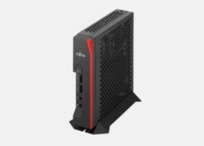
A new desktop thin client and two new notebook thin clients from Fujitsu offer compact computing for businesses who use a centralized access server to protect company data and improve security. These thin clients run low-powered hardware but offer fast networking connections. The operating systems supported are eLux RP6 or Windows 10 IoT Enterprise.
The notebook-based FUTRO MA576 and MU937 are expected to release around the end of April in Japan at retail prices of JP¥99,500 (US$930) and JP¥158,900 (US$1480) respectively. The desktop-based FUTRO S740 should release in late May at an MSRP of JP¥59,600 (US$555). While this initial release is for Japan only, Fujitsu devices often make it to Europe not long afterward and some models have started appearing in the United States now too.