Intel New Standard for Thin Client
The landscape of enterprise computing is shifting. As businesses adopt hybrid work models and Virtual Desktop Infrastructure (VDI), thin clients have become critical for secure, manageable, and cost-effective endpoints. Central to this evolution is the adoption of Intel’s N-series and U-series processors as the default silicon, powering devices like the HP Elite t660 and modernized clients from manufacturers like 10ZiG. These processors deliver the ideal balance of performance, efficiency, and capability required for today’s demanding work environments.
Performance per Watt: The Efficiency Engine
Thin clients demand efficient processing to minimize power consumption and heat in centralized deployments. Intel’s latest N-series, exemplified by the N100 processor found in many 10ZiG thin clients, and the U-series, like the U300E in the HP Elite t660, are engineered specifically for this balance. The Intel U300E in the t660 provides robust performance for multitasking and video conferencing while maintaining energy efficiency, a key factor for 24/7 operation and achieving certifications like ENERGY STAR®. This performance-per-watt advantage translates directly into lower operational costs and a reduced environmental footprint.
Advanced Codec Support for Seamless Collaboration
Modern work is collaborative, making high-quality video conferencing a non-negotiable requirement. Intel’s integrated graphics within these CPU families include dedicated media engines with hardware-accelerated support for modern video codecs. This ensures that thin clients like the HP Elite t660 can smoothly handle video calls on platforms like Microsoft Teams, Zoom, and Citrix, without taxing the central server. Users experience clear, fluid video and audio, making remote collaboration as effective as being in the office.
Multi-Monitor Productivity as Table Stakes
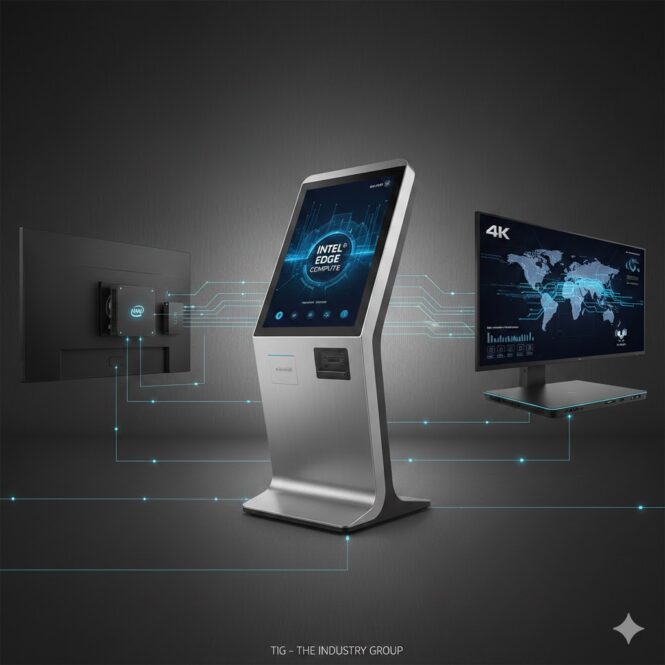
Productivity in finance, design, and control rooms often depends on multiple displays. This is where these processors shine. The Intel U300E in the HP Elite t660, for instance, supports up to four simultaneous 4K displays via its comprehensive port selection. This multi-monitor capability is no longer a luxury but a baseline expectation. It allows professionals to spread out applications, monitor real-time data, and enhance workflows, all driven efficiently from a compact, silent thin client.
A Foundation for Security and Manageability
Beyond raw performance, this silicon provides a stable foundation for the security-centric design of modern thin clients. Paired with operating systems like HP ThinPro or Windows 11 IoT Enterprise, these CPUs enable features like write-protected file systems and seamless integration with security dashboards like HP Wolf Security. The result is a hardened endpoint with a minimal local attack surface, crucial for industries like healthcare and finance.
In conclusion, the shift to Intel N-series and U-series CPUs represents a strategic alignment with the needs of modern IT. By offering an optimal blend of energy efficiency, robust media support for unified communications, and powerful multi-display capabilities, processors like the Intel U300E empower thin clients such as the HP Elite t660 to deliver a full, secure, and productive desktop experience from the cloud. For organizations future-proofing their endpoint strategy, this silicon is not just an option—it’s the intelligent default.
Perspective
China’s digital transformation story isn’t just about software or AI headlines. It’s also about rethinking the endpoint — how people actually work, access systems, and manage infrastructure at scale.
Chinese enterprises are under real pressure to modernize office models while tightening IT architecture. That’s where professional thin client platforms like the HP Elite t660 and 10ZiG come into play. The value isn’t just hardware specs or security certifications. It’s alignment with what the market actually demands right now: cost control, operational efficiency, supply-chain stability, and measurable energy reduction.
In sectors like finance, healthcare, government, and large-scale manufacturing, centralized endpoint management and cloud-based delivery are becoming standard practice. Long lifecycle hardware, lower power consumption, and centralized control aren’t marketing bullet points — they solve very practical challenges around uptime, sustainability, and long-term infrastructure planning.
There’s also the reality of hybrid work. Multi-screen 4K support and reliable video collaboration aren’t luxuries anymore; they’re baseline requirements for cross-regional teams operating at speed.
I wouldn’t describe these devices as just endpoints. In the right architecture, they become part of a broader strategy — secure, manageable, and sustainable digital operations. When done correctly, the endpoint stops being a vulnerability or cost center and becomes stable infrastructure that supports intelligent transformation instead of complicating it.